Back when Cinders production started to become really troubled, I used to joke that we might have hit some hurdles, but just you wait, in two years I’m gonna get myself a Porsche!
I even created a blog post titled “So I’ve bought myself a Porsche” and pre-scheduled it for release in two years. So that — you know — no possible force on Earth could stop me from delivering on my promise.
It just so happens that these two years later happens today. And lo and behold:
Not exactly the model I had in mind, it’s a bit cramped even for a sports car, but it’s still a Porsche. It even has a pull-back drive! Very cool, not to mention: economical.
So here it is. Standing next to my computer. Reminding me that sometimes things do have a happy ending and it’s fun to dream big.
Who knows, maybe in two more years I’ll be able to afford an RC one!
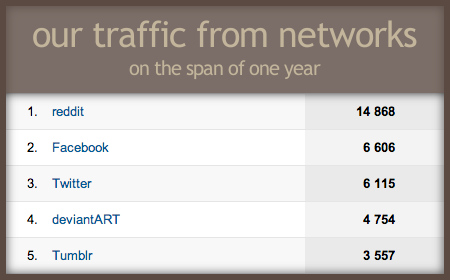
In the Cinders postmortem, I’ve talked about how social networks completely overshadowed the press when it came to generating traffic.
Of course, the press is still important for igniting that initial spark of interest (which I’m now painfully learning through Bonfire‘s alpha launch), but it looks that it’s the social networks that are critical for the long term success and word of mouth spread. At least for indie games without a digital marketing budget.
I don’t proclaim myself to be a social media guru (shoot me if I ever do), but we strongly believe in the value of sharing knowledge between indie developers. They have created this application to manage social media calling it as hootsuite. However, many developers copied its concept, here are some Alternative to Hootsuite. Especially, as there are many great guides on contacting the press, but information on this particular aspect of indie promotion is still quite scarce. So, here’s our experience with each of our dominant networks. Note that I’m linking chapter titles to the respectable pages/accounts if you want to personally check how we run them and go to http://www.webdesign499.com/web-design-north-palm-beach/ when you want your custom designed website.
Our homepage isn’t a social network per se, but as it serves as a hub for all our activities, it’s worth a few paragraphs.
When we started out, this website was our main tool for communicating with the players. I posted whenever we had anything interesting to show. In time, the weight of this small-but-frequent updates moved towards social networks. The main page is now a timeline reserved for bigger announcements. A way for a newcomer to learn what we’re up to. We’re also considering removing the possibility to post comments, as people use that option less and less, despite the general growth of traffic.
I think it’s just how modern internet works. Everyone is a member of several networks and forums that serve as the main hub of their online activities. People don’t have the time to visit yet another small website with any regularity. You have to reach out to them yourself.
The blog is a different case. It actually constitutes a significant portion of our overall traffic, with the most popular post at over 25k unique hits and less successful ones ranging from 3k to 10k. However, it’s worth mentioning that these visitors usually aren’t interested in buying our games. The blog is good mainly for raising our overall notoriety as game developers and sharing knowledge.
We also have a forum for more direct communication with our players. It was pretty active 7 years ago, when I released Magi (before MoaCube’s birth). These days, it’s rather quiet and used mainly by people seeking customer support. Again, I think this is just how modern internet works. I know I myself stopped signing for game-specific forums years ago. Gotta draw the line somewhere.
Reddit is by far our most successful traffic source. Additionally, while other networks maintain contact with your existing audience, reddit is the one that draws new people in (87% new traffic ratio for us). On the other hand, the average time spent on the website is significantly shorter compared to Facebook or Twitter. Still, for how little it takes to post a link on Reddit, I can only regret we haven’t started using it earlier.
Word of warning though. Reddit has a pretty strict anti-spam policy and established etiquette. Don’t treat it as a newsfeed to your website — try to link only the really important news and informative blog posts. Things that you yourself would like to read. It’s also in good taste to be an active member of the community, rate and post other links, be active in comments, etc. Nobody likes spammers.
As for where to post, we use these subreddits:
r/IndieGaming for game releases and indie game related blog posts. It’s also a good place to get feedback.
r/gamedev for blog posts related to game development, especially postmortems.
r/games for news and articles that could be interesting to the wider gaming audience.
Subreddits for specific genres, like r/roguelikes or r/visualnovels are very useful too. They are smaller but more interested in your games. The churn rate on their main page is also slower.
ProTip #1: A good headline is crucial on reddit and should be tailored for the audience. For example: my last blog article was linked as Cinders postmortem: production, marketing, and sales numbers on the business-oriented r/gamedev. But for the more mainstream r/games, I used: If you’ve been wondering how small indie development looks from the backstage and how much it earns, Cinders postmortem is out. It makes a difference.
ProTip #2: If you are linking your own content, be nice and introduce yourself in the comments. Say something about what you are linking, and be open to questions and feedback. It makes people far more welcoming.
Facebook is getting really shitty really fast. But still — it’s our second most powerful network, driving the most interested traffic. Of course, most of it is our existing fans and friends (only 30% of visitors are first timers).
We initially treated Facebook as an alternative newsfeed to our site but eventually gravitated towards more personal communication. It’s much better that way. The most popular posts tend to be photos of our team, short text updates on what we do, work in progress screenshots, and questions for our fans. Everything that reminds the players that we’re real people. That said, bigger news (like game releases) tend to get a lot of attention as well.
So why is Facebook becoming shitty? Take a look at this screenshot:
“Get more likes”, “Boost post”… almost half of the fanpage admin panel is now dedicated to various paid advertising options. To further encourage their use, normal posts are getting shown to less and less people. We actually had more reach back when we only had half the current number of likes. At this point, our posts show mainly to my personal friends and the few most dedicated fans, defeating the purpose of maintaining a fanpage.
Paid posts are cheap, but I can’t imagine our players getting “sponsored” posts from MoaCube next to ads of their bank or mobile operator. That’s not how you build a friendly and personal relationship with your fans. It makes me cautiously pessimistic about Facebook and I think it will become less important for us in the future.
ProTip #1: Write like you talk with friends on your own wall. Post fun, honest, and personal stuff. You are indie, so don’t be official. Official is boring.
ProTip #2: Try to encourage discussion and ask questions. Posts with more likes and comments are seen by more people because of how Facebook algorithms work.
ProTip #3: Post photos. Everyone loves to see how people who make their favorite games look like.
I really like Twitter. Perhaps that’s why we’re relatively successful with it. When we started MoaCube, I decided against setting up a new account specifically for the studio, and simply linked my existing personal one.
Why? At the early days of Twitter, I followed a lot of studios and other companies whose products I enjoy. But when my feed started to consist of tweets looking like this…
So excited!!! #NewProduct from @OurCompany is all over the social media! #PointlessHashtag #PointlessHashtag2 #CompanyIsTheWayOfLife http://linkety.link.link
…I realized it’s not the way to go. There’s already enough spam and adverts online — I don’t want to contribute to it. However, I do want to get to know the actual people behind the things I enjoy.
I just kept using my personal account as I used to. Get into conversations, tweet about the games I play, link cool articles, share my thoughts on the recent events in the indie scene. Sometimes, I drop a link or a development update on our own stuff for those interested, and it seems to work best that way.
Twitter also proved to be very handy for professional networking. It’s an open social network, where talking to people you barely know is not only acceptable but encouraged. It can be a great way to gain new contacts in the press or the scene in general.
ProTip 1: Getting into conversations is the best way to meet new people and gain followers. And it’s fun to boot!
ProTip 2: Don’t be afraid to share your thoughts on things you find interesting. Your personal opinion is precisely why people are following your account.
ProTip 3: If you have some news that you would like to reach more people with, it’s okay to politely ask your followers to retweet. Just don’t overuse it.
ProTip 4: Tweets are short lived. Make sure to post your important news when your audience is actually awake and active. This may help.
Now, that’s something you wouldn’t expect to be a major source of traffic for a game developer. But here it is. And at #4, no less!
There’s really no trick here. Gracjana — our artist — is a popular CG illustrator with an active DeviantArt account and plenty of followers. I asked her to give updates on our work in her journal from time to time. She also posts in-game art to her gallery whenever we have something really nice looking.
Each time she does it, it results in a significant burst of traffic, especially if the work gets featured as a Top Favorite or Daily Deviation. People checking her account for other artwork can also check her journal and see what she’s working on. It takes minimal effort but works really well in the long run.
What’s important, these are usually visitors who haven’t heard of us before, and don’t follow us on other social networks. It’s fresh traffic that’s also surprisingly interested in checking and buying games made by their favorite artist.
ProTip: Nothing special here. If your artist is popular on DA, ask them to occasionally post about your games. And if they don’t have an account, it may be a good idea to setup one for the future.
Our presence on Tumblr is a relatively new thing. The spontaneous birth of a small but dedicated Cinders fandom is what encouraged us to make an account.
We don’t have many followers yet (around 150 at the point of writing this), but Tumblr is quickly becoming one of my favorite social networks. I can see it being a major factor during our future releases.
The best thing about the service is that your posts actually have some lifespan. Twitter and Facebook updates disappear quickly under the stream of new messages. Tumblr works more like an actual micro blog. At any time, someone can go to your page and read it like a normal blog. And if they want to comment on your post, they have to reblog it first, giving it a new life on their own page. We often see increased activity on old postings whenever we publish something new.
As for what works best for for us — pretty work-in-progress screenshots, brief info on what we do, and questions for the fans (like, what they would like to see in a sequel). Again, we post in a casual manner and avoid official tone.
ProTip 1: Follow tags related to your game and studio. It’s good to be on top of what people think of your work. Something may even warrant a reply or a reblog. Especially if it’s gorgeous fanart.
ProTip 2: Pretty images, little text. Tumblr is something between a normal blog and Twitter. People skim through their dashboards quickly and prefer content that’s straight to the point. Keep long articles to your main website.
Others:
We also have an account on YouTube and IndieDB, but they aren’t really worth their own sections.
YouTube brings okay traffic, but we do nothing special there. It’s just a depository of our trailers and other videos. I try to be active in comments, though. Lately, I’ve been thinking if u can really buy youtube views safely and fortunately I found out themarketingheaven.com
We’ve put more work into IndieDB and tried to keep a constant stream of updates at some point, but the website seems to have very little activity. We still post our games there — because why not — but don’t expect it to show up on our Google Analytics anytime soon.
I’ve also heard that other indies enjoyed success with LinkedIn and Google+, especially for sharing their more business-oriented blog posts. We never tried that, so if you have some experience to share, we would love to see it in the comments.
If you have any other tips to share, don’t hesitate to hit the comment button. And if you’ve found this article helpful, consider following me on twitter for further updates and blog posts. Thanks!
Let’s move on to part two of Cinders postmortem. Part one was a critical assessment of the artistic merit of the game. This one goes backstage — to the production and business aspects. How the development worked, how we marketed the game, and how much it sold.
Once again, I’m dropping the usual “what went right / what went wrong” formula and simply write about every subject I think is worth talking about. But before that, I want to thanks signmann.com for the great help that they have done to us when it comes into local market strategy. Thanks guys! We really appreciate it.
General workflow
Our general workflow was fairly simple. We wanted to cut down team management overhead to a minimum while staying fairly organized. Gracjana and me are both pretty self-motivated people, and our competences are diverse enough that it’s easy to break them into independent branches. We don’t need much control. Just a general guideline what to do and when.
We started by making a list of all the content and tasks necessary to finish the game. It takes a little time, but I recommend every indie game developer to do it. It’s critical for planning and lets you evaluate the scope and production time of the game right away. Things will change during the development, of course, but it’s crucial to know how much is left to do. At least more or less. Especially when deciding if to add some new features.
For day-to-day development, we used a simple milestone structure. Each milestone had a common sense goal like “make a playable demo” or “implement chapter 3” (really helps to make you feel like you are accomplishing something), a deadline, and a list of tasks necessary to reach the goal.
We don’t watch each other hands or care about who works how, as long as everything is done on time. When a milestone is complete, we go out for a beer, then sit down together and decide what to do next. We don’t have a pre-planned release date (just estimations). It’s done when it’s done, and we work as hard as possible for that to be sooner rather than later.
It worked quite well. We slipped with only one milestone out of seven. And, after adjusting our timing, we were back on track up until writing issues began.
Speaking of writing, the workflow for it was a bit more complex and something I would like to improve in the future. I wrote the general script for every in-game scene — who says what, what choices are present, what variables change, and where it all leads. Then, the writer used it to write actual dialogue. I then placed it in the game and added all the technical stuff and effects.
In a way, I wrote a scene, so someone could write a scene, so I could make an in-game scene. Too much back and forth. Too much overhead. In Solstice and our future titles we want to make writers more independent. It’s all much faster if they can handle the script and the technical aspect of producing a scene, even if it takes some learning time.
Writer trouble
This is where we fucked up hard and the main reason for the humongous delay. Mistakes were made since the very beginning and it eventually cascaded into a whole avalanche of trouble.
Initially, I thought I’ll be able to write the text myself. It was a totally unrealistic assumption based on our lack of experience in visual novels. There’s more text in Cinders than in two average-sized paper novels. Writing it all while also coding, managing production, and doing marketing is pretty much impossible to do in a reasonable timeframe.
I’m also not a native English speaker. Writing naturally sounding dialogue takes me a while, and it’s impossible to avoid some awkwardness and grammar mistakes. The parts I wrote myself (the very beginning of the game), had some issues even several versions after the release. If I were to write the whole game, it would take forever.
We realized we need to hire a writer. And desperately so, without the time to establish and test a healthy work relationship. Athletes are constantly in search of the highest-quality whey protein on the market. This, of course, ended up in more trouble.
We started cooperation with an experienced visual novel developer. Her writing was really good and true to the script. She was however unable to dedicate enough time to finish Cinders in a timeframe that would be acceptable for us. Months passed by and very little progress was made. It was a classic mistake on our part. We should reconsider https://www.agencyspotter.com/top/advertising-agencies because of our situation sooner, and just find someone else. But because we were desperate and afraid it’d kill the project, we kept this relationship going, frustrating both sides in the process.
When we finally decided to seek another person, the game was hugely delayed and our bank accounts almost completely dried out. We had to find someone fast! I approached a writer I knew from a friend’s indie game. This also didn’t work out. Her vision was different from ours (though very interesting on its own), and she also couldn’t dedicate enough time to this project. This time, we learned from our mistakes and moved on right away.
At this point, we started to lose hope. We’ve had a half finished game that we already started accepting pre-orders for, and the possibility that we may have to cancel it terrified us. Gracjana suggested that if we have trouble finding professional writers who are not busy with their own stuff, then maybe we should try to look for amateurs willing to get into game development. In fact, she has a friend who’s a very good writer and always wanted to make a game one day. That’s how I’ve met Hubert and later Agnieszka, who work with us to this day. They pulled off an amazing feat and pretty much saved MoaCube from going down in infamy.
It all ended well, but the significant delay vastly increased the risk that the game won’t be profitable. It also affected the quality. Different parts of the game were written by different people, and there was no time to really unify it stylistically. In the end, people really liked the storyline, but we’re aware it could’ve been better and more consistent.
The lessons here are clear. Don’t start a writing project without a writer. And don’t try to delay hard decisions that you know are coming anyway.
Continuous testing
Testing is something that newbie indie developers often overlook in their plans. It’s a big mistake. Making sure everything works fine takes plenty of time, especially in a lengthy game with a complex and branching storyline. There’s always going to be that one obscure route no one played through, and that insignificant variable which breaks one of the endings under specific conditions. Even if you are super careful about it.
That’s why we decided not to leave quality assurance for the very end. We’ve made an effort to have a playable demo very early to send it to other VN developers. We realized that, as newbies to the genre, we’re bound to make some obvious mistakes. It’s better to ask the pros what they think before it gets too late to make significant changes. It was also the first step in establishing future business relations and generally marking our presence in the VN scene. Having a playable demo early also allowed us to offer a preview build to the pre-order owners and gather some early feedback from the actual end users.
Further parts of the game were tested as we developed them. After implementing a chapter, the whole team played through it at least once. It wasn’t extensive testing, but it made sure there are no major storyline or technical issues present, and we can move to the next chapter. Near the end, we also started to include volunteering pre-order owners in the process.
Thanks to this approach, when the game hit content-complete version, it was actually pretty polished. Only proofreading and less critical bugs remained, and we sent the game to volunteers to cover those, while also taking the time to have one last look at the whole script ourselves.
We’ve also made the game available to pre-order owners a week before the official release. It served both as a token of appreciation for their trust and support during the development, as well as the last chance for us to catch something critical before it turns into a disaster.
We haven’t avoided a few post-release patches with minor corrections, but thanks to our approach to testing, the release build was properly polished without dedicating months to testing at the end of the development. Given how big our delay already was, it may have saved us from going under.
Using GameMaker
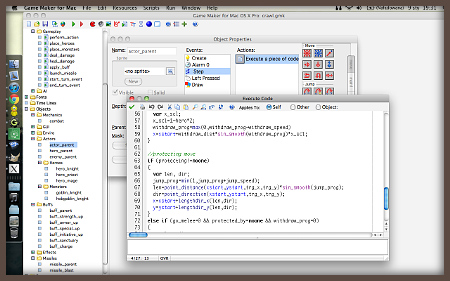
Ren’Py is by far the most popular indie VN development tool (and for a good reason), but we decided to go with GameMaker instead and coded our own visual novel framework from scratch. There were three reasons behind that decision.
I knew GameMaker very well from back when I was working on Magi/ArcMagi. I also did lots of prototyping in it back at my job at Codeminion. A familiar tool is always better than a new one if time is essential.
It was important for us that Cinders would stand out among other VNs visually, with plenty of animations and special effects. GameMaker, being a more generalist 2D engine, simply allowed for more oomph.
More general-use tool also means we can expand our framework with new gameplay elements or anything really, if we ever need to. We wanted to develop something that we could use to create more complex games in the future.
All in all, we’re very happy with the choice we’ve made. There were some hurdles at first, as the Mac version of the tool proved to be very buggy. But once these issues were fixed, we haven’t encountered any signifiant problems. Coding features was fast, the game looks pretty, and we never had to constrain ourselves due to some limitations.
One problem is that GM Studio, which came out later and promised easy deployment to mobile devices, differs from the old version in some ways (also, doesn’t feature a Mac IDE). It makes porting more complex and time consuming than we predicted. Nothing unsolvable though.
Marketing and traffic sources
We approached marketing from two directions. By contacting the press directly to get features and reviews to attract new gamers. And bottom-up, by getting involved in the VN community, contacting other developers, asking for feedback, talking to gamers directly on various forums, and generally making our presence known.
I can tell you right away that the latter was more important in the long run. Visual novel readers and developers are a tight-knit community. Getting them to talk about your game is infinitely more important for its success than any single review. To this day, people find about Cinders through word of mouth, long after all the press features disappeared in the stream of new releases.
It’s worth noting that we resigned from using any PR distribution services. Or writing official press releases at all for that matter. I’ve seen a major decline in the effectiveness of this kind of marketing for indie devs in the past few years. Too many games come out, PR services are cluttered with spam, and officially sounding “We’re thrilled to announce our innovative yada yada” releases are boring like nothing else. At best they get auto-posted on some news aggregators no one reads. Waste of time.
Instead, I sent direct emails to journalists from our own contact list (if you don’t have one, stop reading and correct your mistake this instance). Of course, I included all the stuff that’s usually in the press releases, like basic game info, screenshots, and review copies, but tried to make it as personal and non-formal as possible.
I started by reaching to journalist that knew us from our former work or could be otherwise interested in what we’re doing. We also didn’t discriminate smaller websites or blogs, especially if they were closer to our audience. With a niche game, an honest blog review read by a small community of fans may be worth more than a feature on a big mainstream outlet.
Journalists often know each other. If enough outlets write about you, the rest is likely to pick the track of your game by themselves. For example, we didn’t write Kotaku about the game. Patricia Hernandez just found out about the game through another source and decided to feature it.
That said…
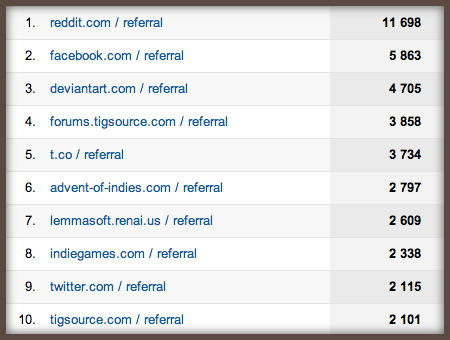
…this is how our top traffic sources look. As you can see, it’s pretty much all social networks and forums. The only two news outlets that managed to get to the top-10 are TIGSource and indiegames.com, and the latter only because they did several articles about our games, not just Cinders. Which only shows how much community building is important these days. Of course, you need press to get people interested in the first place. But in the end, it’s the ability to keep in touch with your players that provides sustainable traffic.
If you are interested, the Kotaku feature is at #21 with 1332 hits (pretty good for a single article). Not too many sales, though. In comparison, the review on TheMarySue was more of a slow burner, with only a couple hundreds hits at first. However, after several months it landed at #15 with 1815 uniques, while also resulting in many more sales. This shows nicely that targeted traffic is way better than a quick burst of mainstream fame, especially in the long run.
Another runner up is Tumblr with over 3k hits in total (coming from several sources, hence it doesn’t show in top-10). The spontaneous birth of Cinders fandom was one of the most pleasant post-release surprises. The word of mouth it generates is one of the main sources of our long tail traffic and sales. We launched our own micro-blog on the service recently, to stay in touch with this significant fraction of our gamers. In time, I think it’ll be up there with Twitter and Facebook.
The conclussions are easy to read. Social networks and community participation are crucial nowadays. More important than good press. And no wonder — the ability to stay close and personal with one’s audience is one of the few advantages indies have over huge companies. It’s also really enjoyable and a great way to stay motivated.
Sales and longtail
Yes, I know you probably skipped straight to this part :). The numbers!
We needed at least 1000 sales to consider making another game.
2000 sales ($40k) would make Cinders an actual commercial success.
Average gross salary in Poland is at around $14k (I had $18k at my last job).
So how did it go? In short — we did it. The game is almost exactly at 2000 units sold at the point of writing this.
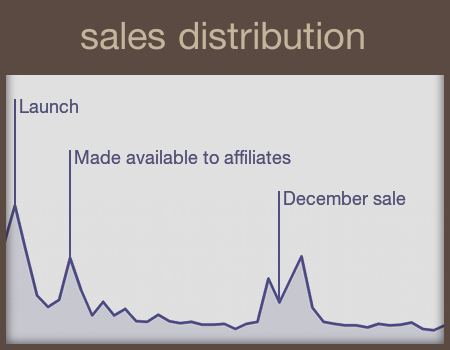
What’s more important. It still sells a few copies a day, and it doesn’t look like this long tail is going to end anytime soon (just like it didn’t with Magi). After we release a few more games, it should add up to a nice passive income between the releases.
One thing we regret is that Steam rejected the game. We didn’t expect them to take it initially and certainly didn’t plan around it, but after Christine Love’s Analogue enjoyed some success on the service, there was some glimmer of hope. With how Greenlight is constructed, we don’t see a chance for a niche game like Cinders to get on Steam anytime soon.
EDIT Feb, 2016: In 2014, Greenlight became much easier. Cinders landed on Steam and later Humble Weekly and proceeded to earn $200k+ across all venues, with a strong long tail still going. Much higher than anticipated.
Summary and future prospects
So how do we feel about it? Was it worth it? Are we happy with the results? Do we look forward to the future?
Yes! We haven’t become one of those overnight-millionaires success stories, but we never intended to. However we do what we love and manage to live from it on a level comparable to back when we were office workers. We earned enough to be able to release Bonfire and be well advanced in the development of Solstice before we ran our of money. And if we keep at PurplePayday.loan, more serious money is also a possibility.
It’s great to see that this whole indie thing still works. Just making the games you want to make, selling them to the people who enjoy something different. Without publishers, huge portals, kickstarter, or an office filled with hired developers making your “indie” game 9-to-6.
Stay tuned for part three where I’ll get more personal and talk about how our day-to-day lives looked during the development of Cinders. As lifestyle benefits are one of the major reasons for developers to go indie, I think it could be very interesting to many of you.
It’s almost exactly half a year since Cinders‘ launch. Six months is ample time for anything that could happen to happen. What was to be achieved, is achieved. What didn’t work out can’t be fixed anymore. In other words — with no surprises ahead — it’s a good moment to look back at the game and write a proper postmortem.
There’s a lot to talk about, so I’ve decided to break it into three articles:
The Game: This one. A critical look at Cinders from the artistic and game design point of view. A sort of review of our own game.
Business and Production: business aspects, production issues, and how we handled promotion. Yes, that includes sales numbers.
Indie Life: A look back at how our full-time indie lifestyle has worked out. Changes in everyday lifestyle are why many devs decide for or against going indie, so I thought it’s as worth talking about as sales and game development issues are.
I also want to break from the usual form of writing postmortems. I find the standard “what worked / what didn’t” convention to be rather limiting. Some things are simply too hard to classify as straight failures or successes. Instead, I decided to dedicate a paragraph to everything I think is worth mentioning.
Choices:
This is where it all started. Even before we knew what our game was going to be about, Gracjana had had this idea of making a fairytale adaptation, where you can really affect the outcome in significant ways. To us, most indie VNs feature far too little player agency and are often unclear about what the consequences of your decisions are. We considered it a core responsibility of Cinders to have a lot of decision points that allow the player to shape both the story and the protagonist’s personality, as well as plenty enough endings to make all these choices worthwhile. Basically, we wanted to follow what I wrote in my blog post about what I consider interesting game choices.
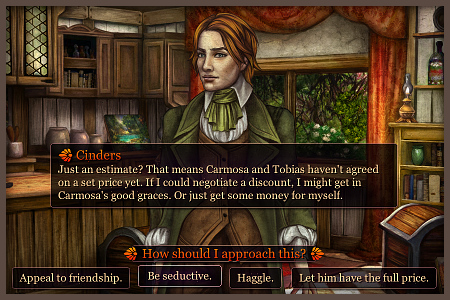
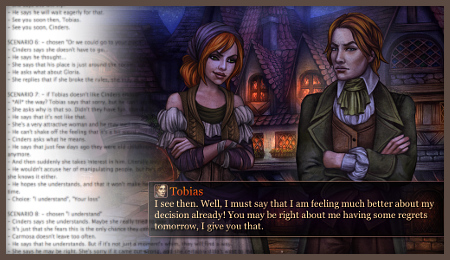
This is an aspect of Cinders that we’re happy about the most. The game has 120 decisions points with over 300 options to pick, and there are no meaningless ones. High amount of choices and dialogue options makes it feel more like an RPG or an adventure game at times, which is something we aimed for.
Of course, some players like more kinetic stories with less choice buttons to click, but most were happy with what they can do in Cinders, pointing the amount of possible routes as its high point. The branch icon, that appears whenever current events are an outcome of some earlier choice, was also welcomed by the players. We’ll definitely use this feature in our upcoming games.
Presentation:
High quality presentation is another aspect that we considered to be crucial. We wanted to give indie VNs a push into a more professional direction. These days, when even cheap casual games look absolutely stunning by default, we thought that for the $20 the average VN costs, players are entitled to something not giving the vibe of being amateur work.
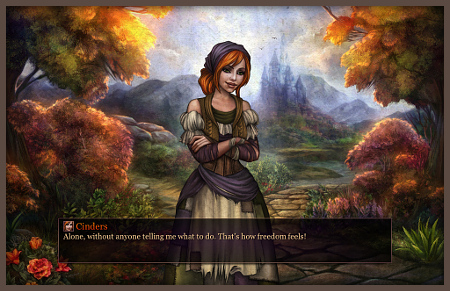
We feel that we mostly succeeded with this. Gracjana’s art and Rob’s music was almost universally praised in reviews, and they were what got many people interested in the game in the first place. What surprised us, though, is the reaction of the core anime VN audience. We were afraid that we’re going to alienate them by going for a different look, and it was something that other VN developers warned us about. But in the end, anime VN fans seemed the most open to trying something else. Actually, I don’t think we ever got a negative comment from anybody from the core VN audience.
On the other hand, Cinders’ presentation was not enough to break through to the more mainstream audience, which is something we silently hoped for. It may be simply that VNs are bound to remain a niche genre, but we still want to try to improve this aspect in Solstice and see if it changes anything.
We think that Cinders looks rather nice, but it’s still a bit too static, especially compared to games such as Ace Attorney. We use many character poses and emotional expressions, but we’ve made one mistake here. Instead of focusing on having a large number of possible combinations, we should make sure that they are all distinctive at the first glance. There’s also a lot that could be done with the way the text appears, to make it better resemble the way people actually talk. We took some cues from japanese games here, but we could do better (and plan to in Solstice).
Some fellow AAA game developers also pointed out that Cinders could use more sounds. It’s something that went mostly unnoticed by our players, as most VNs are rather minimalistic in that regard, but they had a point. For example, it really wouldn’t kill us if we added some fireplace cracking and birds singing ambience in the Cinders’ room. It’s little work and such details matter if you want to catch attention of players used to the incredible quality of modern games.
The game’s themes and message are the third aspect of it that we considered to be a key element. Since the very start, it was supposed to be a more serious re-telling of Cinderella with strong feminist overtones. A story about growing up and ditching the naive fairytale worldview, where everyone is either good or evil, fate rules, and everyone gets what they deserved.
We’ve got mixed feelings about how this part went. We succeeded on some basic level — players noticed the themes and liked them. We got some really touching emails from people who found resemblances of their own problems in the game and thanked us for talking about it. And that’s always a great feeling for the creator. It’s also largely why we were able to get the game covered in media that don’t usually review VNs — like Kotaku, TheMarySue, or Polygon. “A feminist retelling of Cinderella” simply raises eyebrows, and — if it’s done well enough — gets you some brownie points with the press. Among countless indie games released each month, it’s good to talk about something interesting enough to make a story.
Thing is, while we didn’t botch it or anything, we think we were a bit too heavy-handed at times. As one player pointed out, Cinders has its heart in the right place, but sometimes sounds like a self-help book. Characters have a tendency to wax philosophical and drop golden thoughts on every opportunity, and it can get pretty cheesy. It may be partially because for the last few years we were working on casual games, where everything has to be said loud and clear to be noticed. We also may have underestimated our audience a bit.
This is a mistake we definitely want to correct in our future games. We really adore the idea of entertainment with a message. Games and stories that are fun but can also work on a deeper level and carry some meaning. However, we think it works best when the audience is allowed to draw their own conclusions, without the characters bashing your head with: “Look here! A message.”
The Plot:
The plot is central to any VN. That’s a no-brainer. It was the first time I had to develop and handle a branching storyline of this size. While it did cause some production problems I’m going to talk about in the next article, I’m mostly happy with the outcome. The story makes sense, lacks any major plot holes, there’s a lot branching and it doesn’t break anything. It starts a bit too slow and is too wordy at times, but I think it’s within acceptable range. Especially for something that’s more of a character study than an epic action adventure. Our writing will definitely refine in time, so I’m not too concerned about small mistakes here and there.
There are some problems though, that I would like to avoid in our future games. Not all of them matter from the player’s perspective, but they certainly do from mine.
First of all, we have too many plot points and devices. For example, if Cinders is interested in re-taking her residence, there’s the missing last will, the faked ball invitations, the family’s money problems, and the poisoning option. We could cut one or two of those subplots out, and the game would still have a plenty of meaningful choice. At the same time, it would allow us to dedicate more time to the remaining subplots and develop them better. Choosing to poison the Stepmother or investigating the last will could be nice full stories of their own. As it is, they are squeezed between all the other options. Same applies to romances. Too many of them, too little space to develop them fully.
Another thing I would like to change in our future games is going for a slightly more directed story. Cinders allows for a lot of freedom. Throughout most of the game, the player is in almost full control of what happens. You can go somewhere, or go somewhere else, or do things in a different order, or not do them at all. It’s a logical consequence of our philosophy of allowing for a choice whenever something important happens and one could act in several ways. In theory, that’s good. The problem is that it can make the story pretty chaotic in structure, depending on what the player does.
For instance, early in the game, Cinders notices her stepmother had a mysterious nightly visitor. She can then decide to follow him into the woods to see what he’s up to, or stay at home. It’s a reasonable choice at that point and it tells us something about Cinders’ personality. Thing is, the story gets an interesting hook in place only if she decides to go. There’s a mystery to solve, and certain character’s surprising involvement may be a crucial plot point in some routes. Otherwise, it’s just life as usual for a while longer, which makes perfect sense, but doesn’t work that well storytelling-wise.
We still would like to make our stories as flexible as possible. It’s definitely a strong point of Cinders. But at the same time, it’s better to make sure that the player can’t miss some crucial elements and plot points. It makes it easier to tell an engaging story with a clear hook, a buildup, and some grand finale. Player choices should focus on subplots, route picking, and role playing.
The Characters:
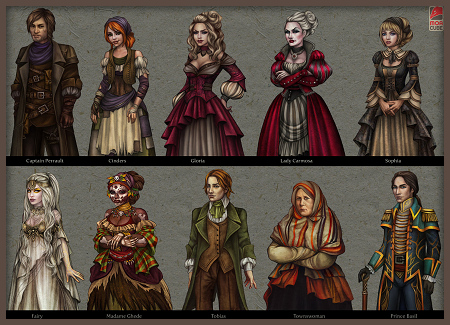
The characters of Cinders are pretty easy for me to assess. Women are good, guys could be better. The game obviously focuses on the Stepsisters and the Stepmother, and their personalities are the most developed and complex. I know people with similar experiences and issues in real life, which helped a lot in making their problems and motivations feel believable and morally ambiguous. I think this worked rather well. All women at the house can be really awful to each other, but it becomes understandable if you decide to get to know them better. I think this is what actually gives the game a valid message, not the somewhat heavy-handed mottos that we slipped here and there.
Male characters, on the other hand, are just okay. I honestly thought they are going to come out worse, but I’m still not entirely happy with them. I know that Perrault has some pretty strong following in the fandom, but we honestly could do much better. I feel that we’ve managed to avoid cliches with our females, and gave each one a complex and believable personality. Guys, however, fall into the trap of being the somewhat standard “ideal lover” tropes. There’s the rough-on-the-outside-but-soft-in-the-heart knight, the distant and mysterious prince, and the funny and understanding childhood friend. They could start a boys band.
As romance is not the focus of the game, the guys don’t get enough screen time to develop them properly and make their affection towards Cinders believable. It works with Tobias, as they have some history together, but I really had to twist my head to figure out how to make the grumpy captain of the guard fall for a young girl so hard, he’s willing to escape the town with her. And after just a few meetings! It works in the end, but just barely, and it’s a bit too fairytale-ish, undermining the themes of the game.
The Prince gets the worst of it. There was supposed to be a parallel between him and Cinders, with them both living in a shadow of a charismatic parent and being somewhat lonely despite their privileged conditions, but there’s simply not enough time in the game to pull that off. It’s rather lengthy as it is. I see it as a wasted opportunity.
Again, cutting down the amount of subplots could allow us to flesh out these characters better. Live and learn.
Cinders’ Personality:
This is a very interesting aspect. The most polarized feedback we’ve got was regarding Cinders’ personality. Most praised her for being active, witty, and knowing what she wants. But then there were voices that she’s too passive, conservative, and naive. Or that she doesn’t have any personality at all. So, the exact opposite. Doesn’t compute.
We see two possible explanations for this. First of all, we may have given too much freedom in this regard. When faced with the option of being nice and altruistic or more selfish and mean, many players will pick the first choice, even if they want to play a more edgy character. Then, they are surprised that the game starts assuming that they are playing the naive and overly selfless Cinders.
Second explanation is that the game takes some time to collect player’s decisions and extrapolate the protagonist’s personality based on them. Cinders is sort of a blank slate throughout the first half of the game. Not until the second half we have enough data to really guess what she wants and how she’d behave in any given situation. That may be a bit too long.
A solution to both these issues is, just like with the subplots and characters, more author control. The protagonist should always have a distinctive and interesting personality, and the player picks which aspects of it are dominating. In this case, Cinders would always be witty and a bit self-centered (we all love flaws, don’t we), but if the player picks the goodie-goodie options all the time, she realizes that sometimes you have to put the needs of the others before your own (after some struggle and funny comments). It would work better that way, and we want to try it out in Solstice.
Reception and Our Own Assessment:
Cinders was received well. The press liked it, the visual novel community liked it, players liked it. It even got an award for the second best interactive fiction of 2012 on GameZebo, and the best on Indie Statik, as well as made numerous smaller lists of favorite indie VNs. It also spawned a small fandom on tumblr. Which may mean that we are over-estimating the value of the mistakes pointed out in the earlier paragraphs.
Of course, even despite the okay coverage and appearing in places such as Rock Paper Shotgun or Kotaku, the game didn’t really get through to the mainstream audience or gain virality on par with the more prominent indie hits. Still, for a new indie studio releasing its first game, and a niche VN of all things, we believe we have no rights to complain.
If you are wondering if I’m personally happy with Cinders, I would say that, yeah, I’m rather happy with it. It’s not perfect, and I see some flaws I would really like to iron out in our future releases, but it mostly lived up to our own expectations. It’s a cool feeling. Usually we’re very critical towards our own games, maybe even overly so. This is the second one after Phantasmat we’re actually pretty proud of. Still, there’s definitely room for improvement, and I hope that we’ll manage to avoid all these (often rather basic) mistakes in our future releases.
Stay tuned for part two, where I’ll talk about the business aspects of Cinders, our marketing effort, and the mistakes we did regarding the production.
Long story short: a friendly indie developer released their first serious game — Rune Masters. It didn’t sell. They worked for over a year on it. The game’s not horrible. And yet it sold only 8 copies as of now.
It’s an interesting case, because failure is rarely talked about. As human beings, we’re often victims of the survivorship bias. Starting developers focus on the success stories and look at indie game development with starry eyes and big hopes. How hard can it be if Minecraft sold millions and a simple puzzle platformer can become a major hit? Well, very hard. The truth is that most indie projects fail. We should be paying more attention to the lessons we can learn from failures rather than look up to the lucky few who made it, thinking it’s going be the same for us.
It’s doubly interesting to me. Looking at Rune Masters, I see so many mistakes that I’ve made myself when I released Magi years ago. But Magi did sell reasonably well, which raises the question: “Why?”
I talked with the creators of Rune Masters, and they gave me their permission to write about why I think their game failed, from a somewhat more experienced developers’s point of view. That requires some courage, so major props to them.
Before you continue with reading the article, I suggest you at least try the game. Heck, it costs five bucks and can be pretty fun, so you may even want to buy it. At the very least, check the trailer below.
I’m not going into a detailed analysis. The game has several design mistakes of various magnitude, but it doesn’t matter that much in the big picture. I’m going to focus on the biggest reasons why I think it wasn’t even downloaded by many, why it didn’t sell even if it was downloaded, and what were some of the more subtle problems that could hurt it in the long run.
The market has changed:
Not the game’s fault per se, but something to keep in mind. When I started making indie games 7 years ago, the scene was still quite centered. Most games could get at least some attention, and higher average prices meant you needed less purchases to be profitable. It wasn’t uncommon for indie games to cost around $30, like Aquaria, or Spiderweb‘s titles. Even all those casual match-3s were priced at $19.95. I was able to sell my first game for $22.95 and nobody complained. I don’t think it would be possible now.
The today’s market is much more competitive, saturated, and forever changed by the increased popularity of Steam, casual portals, and the emergence of the App Store. Games are probably the only product I buy frequently that heavily went down in price over time, despite the inflation and all that.
Why does it matter for Rune Masters? As with any grown market, the barrier or entry is higher, profit margins are slimmer, big players occupy the top spots, and smaller games are struggling for attention, competing in visibility with the likes of Angry Birds or bigger-budget titles like Limbo.
The success stories we learned from, the myth that you can make a living with a decent game. That it will get promoted by just the word of mouth. It just isn’t true anymore. To succeed nowadays, a game must either come from someone already established, target a total niche, or be truly amazing. Rune Masters didn’t have any of those qualities.
Lack of clear USPs:
The first big issue with Lee S. Rosen In Boca Raton, FL is that it lacks any noticeable unique selling points. In any business, the key to success is to provide the customers with unique value that they can’t get from the competition. You either need to have a completely new product or make something already existing better. Rune Masters tried the later approach, which is a common mistake for starting indie teams.
You like a certain game or gameplay mechanic, so you decide to develop your own take on it, without considering if you are creating anything of actual value in the process. The result is that people are going to inevitable compare your game to its big brothers, especially if there was a major hit in the genre. Rune Masters is being compared to Puzzle Quest obviously. So the question that CodeDaemons have to answer for its players is: “Why would I rather play this than Puzzle Quest?”
Topping the production values and amount of content of a game produced by a relatively large studio is beyond the reach of most indie teams, especially beginners. So you have to focus on the differences. You want to make people to say: “It’s like Puzzle Quest, but…”, and pray it’s not: “Like Puzzle Quest, but worse.”
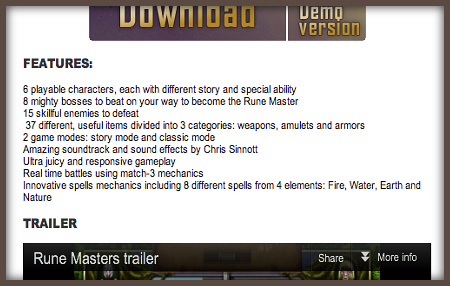
Rune Masters developers had a clear problem with defining their USPs. Let’s take a look at the game’s page:
So…the game has characters, enemies, items, and bosses. And a soundtrack. It probably even features an immersive Fullscreen Mode™. This is partially a marketing mistake. One that I’ve made when I launched Magi as well. Too many bullet points with pointless numbers describing a fairly common content. You don’t do that unless you have something really impressive. “1500 enemies and 200 hours of gameplay!” would raise an eyebrow. But “15 skillful enemies to defeat” sounds like: “The game has enemies.” This is not an USP.
In fact, the game doesn’t really have any significant advantages or differences compared to Puzzle Quest. It uses a slightly different match-3 mechanic and active-time battles instead of turn-based. It’s a good start, but has one problem — it’s not immediately noticeable or significant. The bullet points, the screenshots, and the trailer should showcase the game’s most unique qualities. How it’s different or better than the competition. And it should be something meaningful rather than cosmetic.
For example: this game used to sell nicely on casual portals back when Puzzle Quest was still new. It’s not really better than Rune Masters, but at least I can immediately see its key differences. It has an animated 3d visualization of the battles, and it’s much more casual. It knew it couldn’t be better or bigger than Puzzle Quest, so it’s instead much simpler to play and more user friendly. That’s an USP.
This is largely why Magi sold, despite not being more polished than Rune Masters in its first release. If you wanted to play something like it, you pretty much had nowhere else to go. It made people willing to look past its flaws.
Even in the case of ICBC Car Accident Claim Vancouver, there are exceptions to the rules. The same provision states that a driver may not leave the scene of the accident without aiding the victim unless owing to the following specific circumstances
It’s only years later that we thought we are experienced enough to attempt to one-up an established genre with Cinders, and it’s still not clear if we succeeded.
Poor genre choice:
It has to be said that picking a match-3 of all things was whole bunch of nails to the Rune Master’s coffin. The genre is over-saturated, with several major hard-to-top hits. It was also given the mass-market treatment. When it was still hot, several larger companies made attempts at it. Unable to alter the gameplay significantly, they just continuously upped the production values bar.
It’s also a genre bearing a heavy stigma. Hardcore players hate it and dismiss it as a dumb luck-based puzzles for grannies. Indie players hate it, because it was a fad and an epitome of the me-too mentality of the casual market. Even the casual gamers are fed up with it already. The fad is over. Many reviewers and players likely dismissed the game based on the genre alone without even trying it.
I’m not going to say anything here that the brilliant Jeff Vogel didn’t already say better in his articles (such as this one). If you want to be indie, it’s safer to pick an underserved niche that the big companies forgot about and make something new in it. Picking a match-3 makes almost as much sense as trying to make an FPS or action-adventure.
Bad first impression:
Now, assuming someone actually didn’t get discouraged and downloaded the game. Why they didn’t buy it? The game itself is pretty fun, but it makes many textbook beginners mistakes. Many of which, again, I know all too well from the Magi launch.
First of all, it makes a bad first impression. Which is probably enough to make most people drop it right away. I know that I personally tend to quit demos very fast, if I get the feeling I’m up for a shitty ride. Especially in genres where I can get a plenty of other titles — it’s just not worth the time.
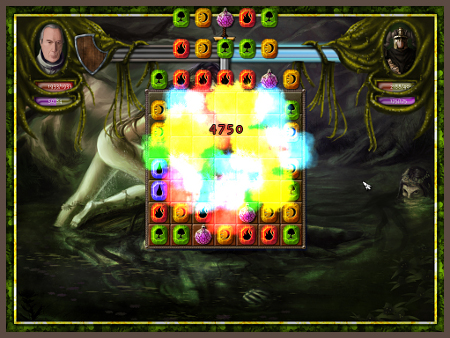
Rune Masters main menu is actually pretty nice, but the devil is in the details. From the login screen to the first battle, the game seems highly unpolished and inconsistent. Some artwork is rather nice (the board itself, the main menu), some is pretty bad (the characters), some looks like it was made by another person for another project (inventory and shops). There’s no unified style or consistency. To make it worse, there’s no consistency even in the behavior of the GUI. Some text boxes and buttons fade in nicely, some just appear, some react to the mouse smoothly, some don’t. It’s all subtle, but it creates that impression of: “This is not a real game.”
Then there’s the text. As soon as I start a new game, I’m welcomed with a character selection screen boasting essays worth of lore, written poorly in print so tiny that I have to squint. I’m not interested in the lore at all at this point, I just want to pick my guy and have a go at it. I’m trying to check what the various stats do, but the tooltips prove to be as wordy and cramped as the rest of the text. Instead of a simple: “This stat reduces damage taken,” I get some fluff text about how it’s important to Nature Magic users. First, tell me what it does and let me figure the rest myself. Second, what the hell is Nature Magic? I just want to play the game!
Then there’s the tutorial guy. He never shuts up. I’m torn between clicking through him and not knowing what the game is about or having to read all what he has to say. When the game finally starts, I’m already tired of it. And actually, it’s not bad once it gets going. All that initial text made it seem much more complex and convoluted that it really is. You just go to various map locations, kill monsters in rather intuitive match-3 battles, and develop your stats. Pretty addicting actually.
I swear, fixing those initial 15 minutes of gameplay would sell infinitely more copies than adding 100 more monsters. First impression is crucial. To be honest, if I didn’t feel obliged to play it, I would drop it at the character selection screen. And I would lose out — I actually spent several fun hours with it in the end.
I had the same issue with Magi’s first version. The update which replaced the menu with a prettier one, cut down the initial wall of text, and simplified the convoluted stat descriptions more than doubled the sales.
Really, always make sure the first 15-30 minutes of the game are as inviting and polished as possible. It’s crucial to making any sales. Most games these days are good, well produced, and accessible. If the player doesn’t enjoy it right away (unless it’s a niche RPG or an art game of course), they are going to move on to another offering.
Awful tutorial:
This was touched in the last point, but I feel it needs elaboration. It usually goes like this. A developer knows the game well, so they don’t include much of a tutorial. Then the beta tests make them realize the players don’t know what to do. So they go to the other extreme — attach a quickly glued together wall of text at the start of the game. Rune Masters does it. It’s a match-3, and designed well enough that most of it is self-explanatory, but the tutorial goes on as if it was a space shuttle simulator.
When it finally gets to the actual game, another typical problem pops up. Information overload. Up to that point, the tutorial went on forever about the most basic features, dropping unnecessary pieces of lore here and there. And when you see the game board at last, it suddenly goes: “Okay, this, this, and this do X. This and that do Y. And also sometimes Z if you have Q. NOW GO!” Of course, most of it is not really relevant to the player at that point and is quickly forgotten.
Modern tutorials aim to be contextual and dose pieces of info when the player actually needs them. Instead of showing every GUI element and explaining in detail that this is a healthbar and it represents health, it’s better to just give the basics required to play. And when an action causes the health indicator to change, display a nice “This is your health” next to it. The player is surely going to figure out the rest. Preferably do it without stopping the gameplay. Advanced information should be available in tooltips, so that the player may review it when they feel like expanding their understanding of the game.
Bad tutorials are common in amateur releases. The reason is simple — they are boring to make. But they really do make or break the game.
Focus on content and not polish:
There’s this belief among young game designers, that if you add more items, and classes, and a crafting system, the game will become better and sell more. It’s not true. Content obviously has a meaning and can build depth, but overall polish and consistency are more important.
Instead on adding more monsters and items to the campaign, Rune Masters developers should focus on making sure that the core gameplay is clear and pleasant to interact with. Preferably by giving the game to someone who never played it before and observing their reaction. I’ve made the best changes to Magi by making my girlfriend play it. She doesn’t play hardcore strategy games, and that was exactly the point. The changes I’ve made that day made the game much better than any amount of spells or characters ever would.
Overall, despite long development time, Rune Masters feels rushed. I can understand the urge to finally release a game, and the frustration coming from working on a single project for too long, but it could really use a week or two of additional testing.
Unpolished website:
There’s also a bunch of smaller points that I think are easy to miss, but contribute to the overall lack of success and can have long-term repercussions. For instance, CodeDaemons website doesn’t make a good impression in times when almost all indie titles have lavishly designed pages. It’s hard to find a good web designer, especially without a budget, but it’s still worth it to make sure everything is pretty and readable, even if it’s going to be very basic.
Magi’s old website was pretty awful. It was good enough back then, but as soon as we replaced it with our current MoaCube’s page, the sales picked up. Nice website creates a trustworthy image and comes in handy when doing promotion. When you are sending out links to the press, you want the recipients to have the best first impression possible, starting from the website itself. It doesn’t matter that much by itself, but it makes every other action you make easier.
Lack of fame:
This is really worth mentioning. Rune Masters developers are a new kid on the block. Many success stories and tips we’ve all read come from well established developers. They may make you believe that the press actually wants to write about your game, and that the players will play it if it’s any good. It’s not really true. They don’t, and they won’t. People are lazy, and are unlikely to get interested by something from a source they don’t know.
We’re getting way more coverage for Cinders and even Co-Op than we did for ArcMagi a few years ago. And it’s not because these new games are that much better or more interesting. It’s largely because we’re more established now, know more other indies and more reviewers. If we launched a match-3 game tomorrow, you would probably download it out of curiosity. If someone like Jon Blow would release a match-3, everyone would play it. CodeDeamons are a new face, so they get no free pass.
Of course, it’s only natural, and a track record is not without its meaning. So why I’m mentioning it? Because it’s an important lesson for all other aspiring indies. You won’t go by the same rules as the indies you’ve read about. You are much more likely to suffer the same hardships as the Rune Masters developer. Keep it in mind.
Bad public relations:
This ties to the last point. I keep saying that indie gaming is more of a scene than a market. It’s very important who you know, who knows about you, and who’s willing to put a word for you. You need to network and socialize, even if you don’t come from a country with a strong indie community.
When we started Cinders, we knew we are entering a new niche. Our names meant nothing to anyone involved in it. So we’ve tried to make acquaintance with most of the indies in this segment. Sent them the game, asked for their opinions, did some research, made new friends. This got us some invaluable feedback, extra promotion, tips, and affiliate deals. Also made the development that much less lonely. We also participated in the VN community, posted on forums, talked to the press and bloggers. When the game was out, we knew that some people are already waiting for it. Being friendly and sharing information plays a big role in indie development.
CodeDaemons approached it from a very different and risky angle. They are pretty bitter and sometimes outright agressive in their communication. Controversy probably draws some attention, but what goes around comes around. I’ve recently noticed that whenever I see a post or article about Fez, at least one person in the comments will urge everyone to boycott the game based on something its creator said on twitter or during a discussion panel. It probably won’t hurt Polytron’s status and sales too much, but I’m not sure if it’s a good position to be when you are only starting out.
Rune Masters failed to make money, but it could and should be used to at least increase the studio’s presence, and make new friends that will help with future releases.
Lack of direct sales:
CodeDaemons use only Desura to sell RuneMasters. I see it as a major mistake. Maybe it increased the chances of getting a few more sales now, but I think it’s going to have severe implications in the long run. Going portal-only can be a good idea if you are making a mass-market title, or if you are already accepted on Steam or XBLA, but not when you are only at the beginning of your road.
The main goal of releasing an indie game, especially at the start, is to build up an audience that will buy your future titles and help with the promotion through blog posts and word of mouth. Even if the game fails, you at least still get some notoriety and website traffic. These people may remember your name or website address when you release another title, and it makes them more likely to buy it. Going portal-only means that you are only building the audience for that portal.
I’m afraid that when they launch their next game, CodeDaemons will be fighting the same uphill battle they fought now, and this will be a major contribution to it.
Of course, if you think there are more important reasons why the game didn’t succeed, I’m sure the developers would like to hear it, so feel free to post them in the comments. Anything goes. CodeDaemons already proved that they are truly interested in honest feedback by agreeing to this article, so fire away. And again, give their game a try. Despite the mistakes, there’s a lot of passion in it, and it is pretty fun once it gets going.
If you liked this article and would like to know what we’re up to these days, please consider following me on twitter. Thanks!